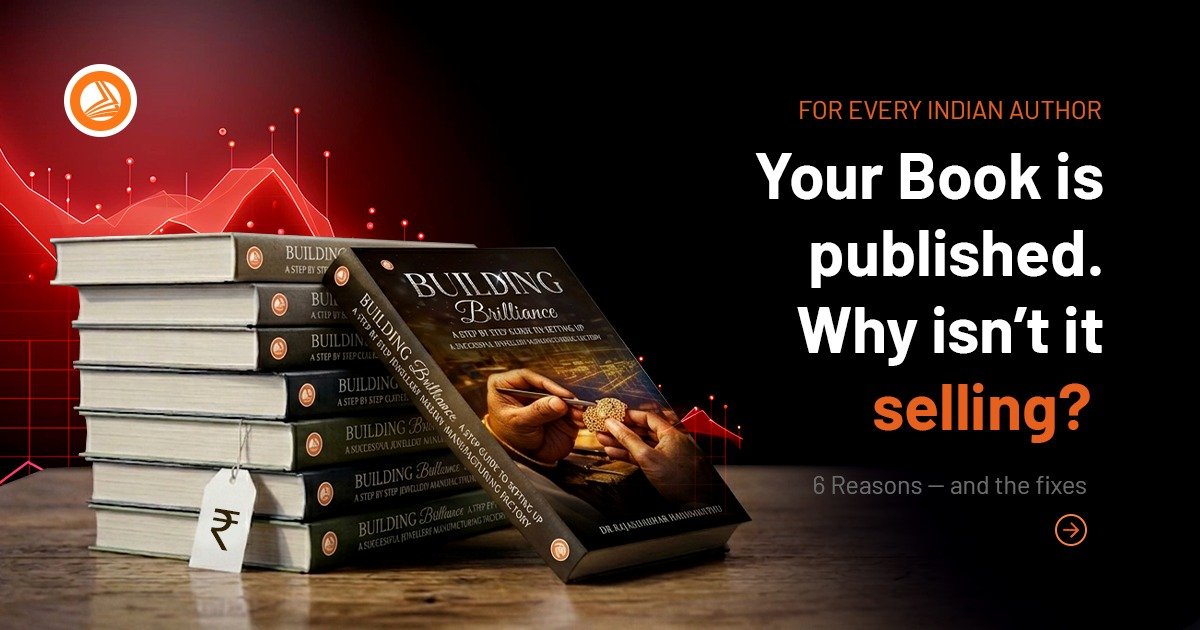
Every year, thousands of Indian authors publish their first book with genuine excitement. A few months later, most of them are asking the same question: why isn't anyone buying it?
We have worked with over 3,100 authors at OrangeBooks. And when a book struggles, it is almost never because of the writing. It is because of decisions made in the weeks before and after publication — decisions that felt minor at the time but turned out to be the difference between a book that found readers and one that didn't.
What follows are the six mistakes we see most often. They are avoidable. Every single one has a fix. And every fix is significantly easier to apply before your book goes live than after it has already struggled in silence for three months.
If you are still writing, or have a manuscript that hasn't been published yet — read this carefully. You are in exactly the right position to get this right.
95% of new books in India sell fewer than 500 copies in their lifetime
Nielsen BookScan India — and the reasons behind that number are almost always the same
What This Guide Covers
| ✓ 6 specific mistakes that explain why most self-published books in India don't sell |
| ✓ The real consequence of each — not theory, but what actually happens to the book |
| ✓ A specific, actionable fix for every single one |
| ✓ The Amazon listing mistake almost every Indian author makes without realising it |
| ✓ A pre-publication checklist to run through before you go live |
First, Let's Be Clear About What's Actually Going Wrong
Self-publishing in India has grown 264% in five years. That is remarkable — and it means that more books than ever are competing for the same readers, the same search results on Amazon, and the same limited attention. In that environment, a good manuscript is necessary but not sufficient.
The authors who reach readers are not always the most talented. They are the most prepared. And preparation — the right cover, the right listing, the right launch approach — is something every author can get right if they know what to look for. Here is what to look for.
⚠️ Mistake 1 — Rushing to Publish Before the Manuscript Is Truly Ready
Writing a manuscript is exhausting. Once it is done, the instinct is to publish it as quickly as possible — to get it out before the energy fades, before doubt creeps in, before something else demands attention. We understand that impulse completely. And it is the single most costly mistake on this list.
Professional editing is not about correcting grammar. It shapes how your ideas flow, how credible your voice sounds, and whether the reader trusts you enough to keep turning pages. In India, where many authors write in English as a second language, an unedited manuscript makes itself known almost immediately — not through any single error but through a cumulative reading experience that feels rough. Readers don't consciously analyse why a book is hard to read. They simply stop.
By the time that pattern generates a bad review or a returned copy, the first impression of your book is already formed. On Amazon, on Goodreads, and among the first people you sent it to — that impression is very hard to reverse.
✅ The Fix
Budget for professional editing before you budget for anything else. At minimum, a thorough proofread. Ideally, a copy edit that looks at structure and flow. The cost of getting this wrong — in lost sales, bad first impressions, and damaged author credibility — is significantly higher than the editing fee itself.
⚠️ Mistake 2 — A Cover Designed for the Author, Not the Reader
Your book cover has one job on Amazon: make someone stop scrolling. It has roughly two seconds to do it — on a phone screen, as a thumbnail smaller than a matchbox.
The most common cover mistake we see: authors choosing colours they personally love, imagery that feels meaningful to them, or typography that looks sophisticated on a desktop screen but becomes completely unreadable at mobile thumbnail size. An Indian reader browsing Amazon on their phone makes a buy-or-skip decision before reading a single word of your description.
Genre conventions exist because readers have learned to recognise them. A self-help book that doesn't look like a self-help book, a thriller styled like literary fiction, a poetry collection that looks unfinished — all of these create a mismatch that kills conversions silently and immediately, regardless of how good the content is.
✅ The Fix
Before approving any cover, open Amazon India and look at the top 10 books in your genre. Note what they have in common — typography style, colour palette, image treatment. Your cover doesn't need to copy any of them. It needs to belong in the same visual conversation. Then shrink it to thumbnail size on your phone. If the title is unreadable or the image is unclear at that size — it needs to be redesigned before it goes live.
⚠️ Mistake 3 — Publishing Into Silence
Here is the pattern we see more than any other: an author finishes their book, publishes it, shares one post on social media, and waits. The silence that follows is not a sign that the book is bad. It is the entirely predictable outcome of publishing to an audience that does not yet exist.
Every author who sells strongly in their first week started building an audience before the book was ready — sharing ideas from it, talking about the writing process, creating content around the topic. By launch day, there were people waiting. Their first-week sales came from a warm audience, not cold strangers browsing Amazon.
In India, where organic book discovery is limited and word-of-mouth drives most early sales, a book that launches with zero momentum rarely builds any later. The first week matters enormously — not because of the sales directly, but because early sales and activity signal to Amazon's algorithm that the book deserves to be shown to more people.
✅ The Fix
Start your pre-launch audience building at least 8 weeks before publication. On LinkedIn, share one insight from your book each week. On Instagram, document the cover reveal and your writing journey. On WhatsApp, personally message 30–50 people who would genuinely benefit from the book — not a broadcast, a personal note. You do not need a large audience. You need a warm one — people who have already expressed interest before the book is even available to buy.
⚠️ Mistake 4 — An Amazon Listing That Does Not Convert
This is the mistake almost nobody talks about for Indian authors — and it is quietly responsible for more book failures than bad covers or poor editing.
Amazon is not a bookstore. It is a search engine for books. When someone searches "self-help for Indian professionals" or "fiction about identity in India", Amazon matches that query against the keywords, categories, and description in your listing. If your listing is thin, generic, or incomplete — your book simply does not appear in those searches. It does not matter how good the book is. The algorithm has no way to know.
Most first-time Indian authors submit a one-paragraph description copied from the back cover, choose the most obvious single category, and leave keyword fields incomplete or empty. The result is a listing that Amazon does not know how to rank.
📝
Book Description Opens with the reader's problem — not "In this book, the author explains..."🏷️
Backend Keywords 7 fields available — fill every one with phrases real readers would actually type📂
Categories Choose 2 specific sub-categories — narrower means faster ranking and more relevant discovery👤
Author Central Page Photo, bio, social links — a complete author profile increases trust and click-through rate✅ The Fix
Treat your Amazon listing as a marketing document, not an admin form. Rewrite the description to lead with the reader's problem or desire. Fill all 7 keyword fields with long-tail phrases your actual readers would search. Select two specific sub-categories rather than one broad parent category. Set up Amazon Author Central with a professional photo, a compelling bio, and social profile links.
⚠️ Mistake 5 — Waiting for Reviews Instead of Planning for Them
Amazon's algorithm treats reviews as a trust signal. Books with fewer than 5 verified reviews receive 73% less organic traffic than books with 10 or more. That is not a small gap — it means a book without reviews is almost algorithmically invisible, regardless of how strong the cover or listing is.
Most Indian authors wait passively for reviews to arrive. They assume that if someone liked the book, they will naturally leave a review. Fewer than 2% of readers do this without being asked. The authors who build up reviews quickly are the ones who made asking for reviews a deliberate, planned part of their launch — not an afterthought.
✅ The Fix
Send 10–15 advance reader copies two to three weeks before publication — to people who will actually read the book — with a specific, personal request to leave an honest review once it goes live. Follow up individually two weeks after launch. Done consistently, this approach gives most debut Indian authors their first 5–8 Amazon reviews within the first month. That is enough to meaningfully change how the algorithm treats your book.
⚠️ Mistake 6 — Treating Publication Day as the Finish Line
Publication day is not a finish line. It is the starting pistol.
The pattern is remarkably consistent: an author launches, sells copies to their immediate circle in week one, shares one announcement post — and then goes quiet. Two months later, sales have stalled completely. The author concludes that self-publishing doesn't work. What actually happened is that marketing stopped at exactly the moment it needed to accelerate.
A book's sales window on Amazon is not 7 days — it is years, if the author continues generating fresh attention, new reviews, and content that drives people to the listing. The authors who sell 100+ copies in year one almost always planned their first 90 days of post-launch activity before the book went live. Not after.
✅ The Fix
Write your 90-day post-launch plan before the book is published. Week 1: personal outreach and ARC follow-ups. Weeks 2–4: share content drawn from the book's ideas on social media. Month 2: approach Indian book bloggers and relevant podcast hosts for features. Month 3: review your Amazon listing — check what keywords are driving traffic and what is not. This is not a large-time commitment. It is a consistent, planned one.
📋 Pre-Publication Checklist — Run This Before You Go Live
Print this out. Go through it in the two weeks before publication. If you cannot check every item — address the gaps first. The time this takes is small compared to recovering from a launch that went wrong.
| ☐ Manuscript professionally edited — at minimum a proofread, ideally a copy edit |
| ☐ Cover tested as a mobile thumbnail — title readable and image clear at small size |
| ☐ Cover genre-checked — compared against top books in your category on Amazon India |
| ☐ Amazon description rewritten for the reader — opens with their problem, not the author's credentials |
| ☐ All 7 Amazon keyword fields filled — specific, long-tail phrases real readers would search |
| ☐ Two specific sub-categories selected — not one broad parent category |
| ☐ Amazon Author Central page completed — photo, bio, social links |
| ☐ 10–15 ARC copies sent — with a specific review request and follow-up date in your calendar |
| ☐ Pre-launch audience warmed up — at least 4 weeks of content or personal outreach before launch |
| ☐ 90-day post-launch plan written — specific week-by-week activities, not vague intentions |
The Books That Find Readers Are the Most Prepared — Not Always the Most Talented
We have seen beautifully written books disappear without a trace — and straightforward, modestly written ones build genuine readerships — because of exactly the decisions described above. Publishing well is a learnable skill. It is not about budget or connections or luck. It is about preparation.
If you are in the pre-publication stage right now, you are in the best possible position. Understand what it costs to publish properly, price your book correctly for the Indian market, and build the infrastructure your book deserves before it asks readers to take a chance on it.
The 95% statistic does not have to apply to you. Most of the authors in that number made the same avoidable mistakes. Now you know what they are.
Not Sure If Your Book Is Ready to Publish?
Talk to our publishing team before you go live. We review manuscripts, covers, and launch plans every day — and we'll tell you honestly what's ready and what needs work. No pressure. No obligation.
📞 +91-810-964-5082 | 📧 info@orangebooks.in
Related Guides for Indian Authors
💰 How to Price Your Book in India
MRP, royalties, and worked examples — know what you'll earn before you publish a single copy.
Read the pricing guide →📦 What Does Self-Publishing Actually Cost?
A transparent breakdown of every cost — editing, design, printing, distribution — before you commit.
Read the cost guide →⚖️ Self-Publishing vs. Traditional Publishing 2026
Rights, royalties, timelines — what each model actually means for an Indian author today.
Read the comparison →